John
John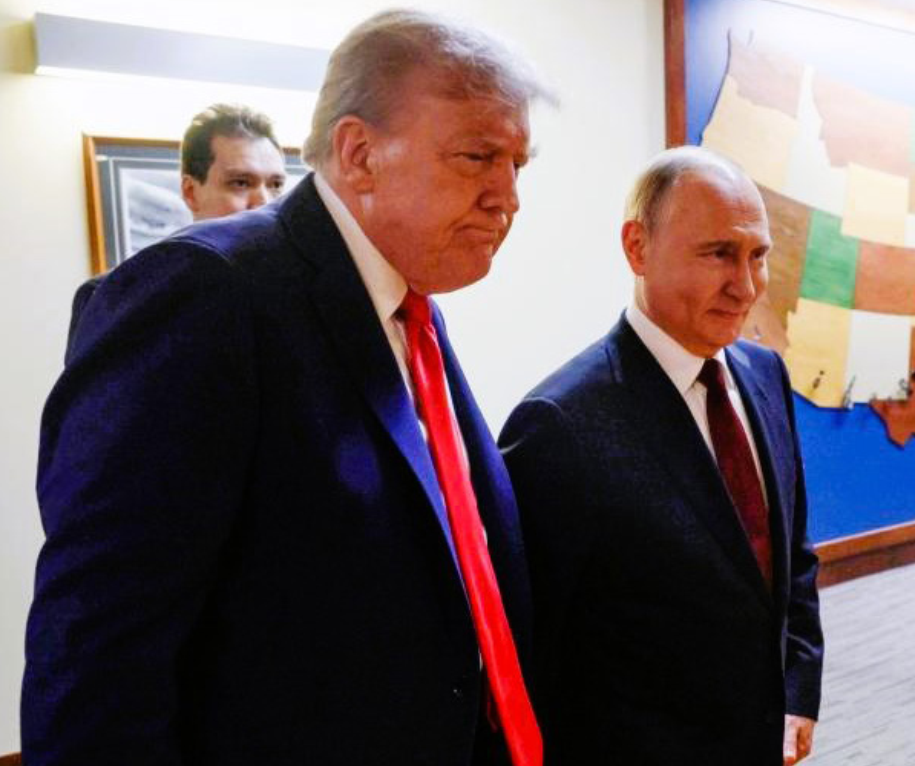
by Theo Russell
Since the historic summit in Alaska between Donald Trump and Vladimir Putin and their top level ministers, our media has been flooded by a tidal wave of deception and diversion, alongside a new campaign of Banderite-inspired anti-Russian demonisation.
The entire world recognises – with the possible exception of senior British military and intelligence chiefs – that NATO has lost the war in Ukraine, leaving total defeat or a negotiated settlement the only possible ways to end the conflict.
As of now, Trump’s position is that a comprehensive, lasting peace deal is preferable to a ceasefire, and that secondary sanctions are off the table. Trump, as we know, can flip his policies on a whim, but there is reason for optimism that genuinely he wants a settlement in Ukraine.
This shift in Washington has thrown Europe’s leaders into a state of panic. The leaders of the ‘Coalition of the Willing’ are facing a political disaster on a massive scale, and as a result they are desperately trying to ways to continue the fight against Russia even with Ukraine reduced
in size.
But while European politicians and commentators queue up to claim Trump has been duped by Putin, they are more dependent on Washington than ever in their insane obsession with defeating Russia.
The full-scale war by the entire NATO alliance against Russia since 2022, has revealed just how far Europe has sunk as a world power. When Johnson, Schulz and Starmer rushed to strangle the Istanbul peace deal in March 2022, they believed their superior weapons and military leadership (training and battlefield command) would deliver an historic victory in Ukraine.
Now Europe’s leaders fear that if they admit defeat they will face terrible retribution from their electorates. Hence their desperation to continue the war and somehow, eventually, to achieve victory.
Their grandiose plans to ramp up military spending, based on bogus claims that Russia plans to invade the rest of Europe, will only push the millions across Europe facing insecure jobs and ever-rising rent, energy and food costs into even greater hatred of their ruling classes.
After Trump’s decision to dump the cost of the war on Europe – by buying US weapons – Europe’s leaders are seeking to prepare a so-called ‘reassurance force’ to be sent to Ukraine after a peace deal has been agreed.
But one European country after another has said that without American support they won’t join this force, including Germany, Italy, Poland, Spain, Romania and Croatia. Even Britain has abandoned plans to send 30,000 troops to Ukraine and is now optimistically claiming that it will send a “more realistic” several hundred “within a week” of a ceasefire.
A group of European states however, led by Britain and France, are desperately clinging on to this plan, the true aim of which was revealed by British defence secretary John Healey, “to secure the safe skies, safe seas and to build the strength of the Ukrainian forces”.
In other words, the goal is use a ceasefire to repeat the shameless abuse of the Minsk Peace to rebuild Ukraine’s armed forces and preserve part of Ukraine as a future base to continue the fight against Russia.
Europe however, is fatally divided. After Germany’s economic collapse without Russian gas, Britain and France have emerged as the dominant European countries and are leading the attempt to continue the war, desperately hoping to preserve their rapidly declining great power status.
For Europe the ‘reassurance force’ is now the key question, but developments since the Alaska summit make it clear that these plans will never see the light of day.
In an interview shortly after meeting European leaders and Zelensky in Washington, Trump stated that no American troops would be deployed to Ukraine after a ceasefire. But he did make extremely vague comments about supporting a European force “in the air”. European leaders have seized on this throwaway remark, translating it into full scale US air support.
Last week Russian foreign minister Sergey Lavrov clearly stated that “we cannot agree with the proposal that security issues, collective security, be resolved without the Russian Federation” and said such plans were “a road to nowhere”.
Moscow has also confirmed that any deployment of NATO troops on Ukrainian soil would be a “red line” it cannot accept.
If that wasn’t enough, four days after the Alaska summit White House spokeswoman Karoline Leavitt said: “Donald Trump is discussing this topic with both Russia and Ukraine. He has directed his team to come up with a framework for these security guarantees that can be acceptable to help ensure a lasting peace and end this war.”
Even Ukraine’s deputy foreign minister Sergey Kislitsa and senior Zelensky adviser Mikhail Podoliak have said that “the beginning of the conversations on the territorial issue is the contact line that is currently there” – in other words acceptance that Ukraine is ready to give up territory.
The summit confirmed two major facts: the complete failure of Western efforts to isolate Russia and destroy its economy, and the emergence of Russia as a global power.
The Ukraine war is also a setback for US imperialism. In 2002, under Joe Biden, Washington also saw a golden opportunity to crush Russia. Now that defeat is looming, the aim is to save face and regroup its forces. But this will still be seen by the rest of the world as a defeat and a further sign that US global hegemony is over.
As for Trump himself, we must be clear that he is essentially a demagogue rather than
a normal bourgeois politician, who seeks to override or dismantle the USA’s normal procedures and institutions.
During his first term in 2017–21 he encouraged the expansion of armed white supremacist
groups, while labelling the Black Lives Matter movement and Antifa as dangerous terrorists.
His second term has been characterised by volatility and international bullying tactics. He has used trade tariffs as a means of blatant political interference against People’s China, South Africa and Brazil, and has massively tightened the trade blockade of Cuba. He is now threatening military action against Venezuela.
He has also revived a long American tradition of isolationism, attempted to improve relations with Russia, and declared he wanted no more endless foreign military interventions – although this did not stop US strikes on Iran.
In his first term, every attempt to improve relations with Moscow saw the ‘inner state’,
led by the FBI, CIA and the ‘Forever War’ party, threaten him with impeachment and succeeded in making him step back.
We can only speculate that this is not being repeated in 2025 because America’s ruling class
realises that it has lost the war in Ukraine. The NATO alliance, with a total defence budget of
$1.47 trillion in 2024, has been unable to match the spectacular increase in Russian military production, from shells to hypersonic missiles, with a budget of under $150 million.
Whatever the reasons, to the horror of Europe’s rulers, the Alaska Summit clearly showed that Trump is serious about a deal, if possible as quickly as possible. We all saw the
warm welcome he gave Putin on his arrival, and he declared after their meeting he would “give
today a ten”.
Trump clearly wants a Nobel Peace Prize and to be remembered as a great statesman, but
we shouldn’t forget his election promises to end foreign wars and “bring the jobs back home” that are the bedrock of his mass working-class ‘MAGA’ base.
This is not an end to the American goal of global domination, but a strategic reorganisation. Trump still supports NATO rearmament, new deployments of nuclear weapons, and a shift – for now at least – to focus on China, Iran and the Middle East.
Our own view is that an end to the war in Ukraine, with a genuine and lasting settlement, is desperately needed by the people of Ukraine and the millions of Ukrainians living in exile. It is also in the interests of millions in the West who have paid the cost of the war, and of the world as a whole.
We also believe that real change in Ukraine itself is only possible after the Banderite dictatorship has been dismantled and the country’s internal conflict is brought to a permanent end.
It is of course possible that the prospects of peace raised by the Alaska summit will not be
realised. But sooner or later NATO will have to accept reality and agree a genuine, comprehensive peace with Russia. That will be a massive defeat for Britain’s ruling class
and its imperialist ambitions.