John
John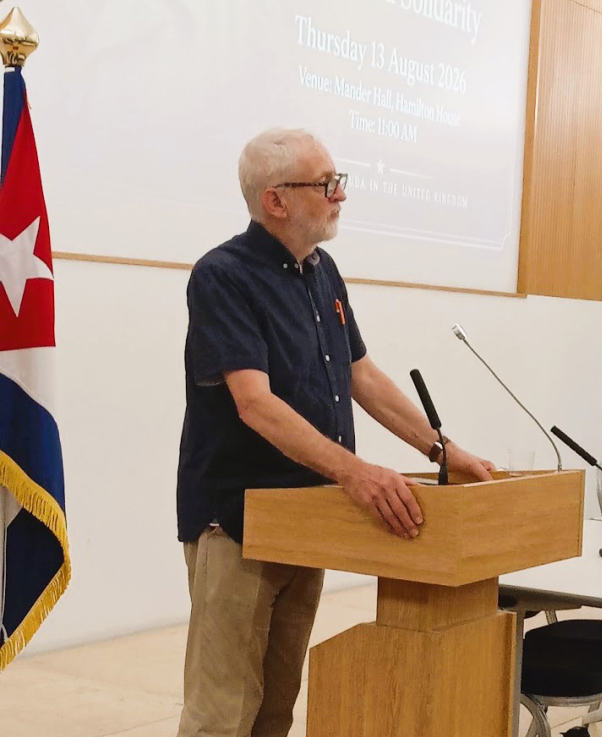
Pictured: Jeremy Corbyn calls for solidarity.
NCP leader Andy Brooks joined over 200 diplomats, union leaders, parliamentarians, academics and long-standing friends of Cuba to reflect on Fidel Castro’s legacy and enduring international solidarity on the anniversary of his birth on 13th August 1926. Mander Hall, at the headquarters of the NEU, the largest education union in Europe, was packed on that Thursday morning last week. By the time the lights dimmed, there wasn’t a spare seat left.
The morning opened with a short tribute film tracing Fidel’s life, his legacy, the achievements of the Cuban Revolution he led, and the international solidarity he built across the world. Woven through it were brief contributions from doctors, trade unionists, academics, filmmakers, campaigners and politicians, each speaking to what that legacy means in their own corner of society. Some of them had actually known Fidel in person. Friends speaking about a legacy. Friends remembering a man.
Jeremy Corbyn, the leader of the Independent Alliance group in the House of Commons, took the platform next and spoke with real feeling about what Fidel built for every corner of Cuban society and for the cause of international solidarity, then went further, calling on Britain to deepen its solidarity with Cuba at every level, including government to government. Coming from someone who, this March, rode in the Nuestra América aid convoy into Havana and stood inside a cancer hospital struggling to keep its machines running through a blackout, with Richard Burgon MP alongside him, those words carried weight.
The Cuban ambassador, Ismara Vargas Walter, closed the event and the room went still. She took us back to the beginning: a twenty-six-year-old leading the assault on the Moncada barracks, captured, standing alone at his own trial to say the words that outlived every judge in that courtroom: “Condemn me. It does not matter. History will absolve me.” Prison. Exile in Mexico. Eightytwo men on a leaking yacht called Granma, scattered on a beach under fire, barely a dozen reaching the Sierra Maestra alive. From that dozen, in under two years, a country and a Revolution.
She reminded us what he did with that victory: over one hundred thousand volunteer teachers, many of them teenagers, walking into the mountains until Cuba could declare itself free of illiteracy. Cuban doctors in Chile and Algeria by 1961 and 1963. Cuban internationalists at Cuito Cuanavale, standing with a nation fighting apartheid – the same struggle Nelson Mandela himself later called a turning point in the liberation of his continent.
And then she brought us to the present: a naval armada in the Caribbean, oil tankers tracked and seized on the high seas, a total fuel blockade, “a profound breach of the equality of states and sovereignty,” in her words, not a bilateral dispute. Families cooking over firewood. Blackouts lasting entire days. Eleven thousand children among more than one hundred thousand people waiting for surgeries that cannot be safely scheduled. Survival for a Cuban child with cancer and infant mortality, fallen. “When a hospital in Havana loses power tonight,” she said, “it is not the weather. It is policy, arriving exactly as designed.”
And still, 300 Palestinian students are training as doctors in Cuba right now, free of charge, because Fidel taught his country that internationalism is a debt paid, not a favour granted. And to be internationalist is to pay our own debt to humanity.
She thanked the National Education Union for opening Hamilton House’s doors to us once again, the 117 MPs who backed this year’s Early Day Motion against these illegal unprecedented sanctions, and six decades of the Cuba Solidarity Campaign’s unwavering friendship. Fidel is 100 years old today, she told the room.
Cuba is still standing!
by New Worker correspondent