John
John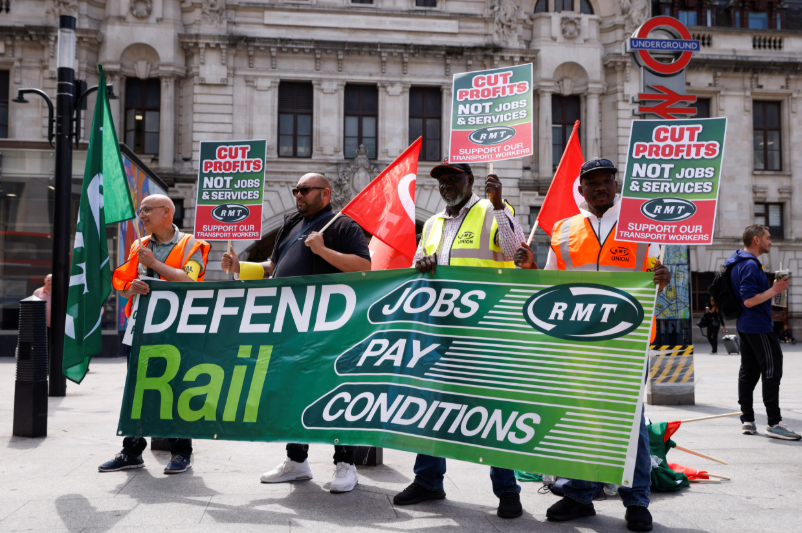
by New Worker correspondent
After last week’s strike by RMT workers on the London Underground general secretary Eddie Dempsey demanded that the Mayor of London (who is now paid more that the Prime Minister) take active steps to resolve the long-running dispute. He declared that Sadiq Khan, as Chair of Transport for London (TfL), needs to stop playing about on social media and start doing his job.
Another London issue facing rail unions is the planned closure by August 2027 of all ticket offices on the new Elizabeth Line, which RMT calls “a betrayal of station staff and passengers”.
Having successfully opposed plans by the late unlamented Tory Government to close ticket
offices across the Overground network, RMT was in no mood to let this go unchallenged.
Dempsey said that: “After the biggest wave of public opposition we’ve seen in years to ticket office closures, it’s beyond belief that similar plans are being put back on the table for the
Elizabeth Line. Against the backdrop of industrial relations chaos across TfL, this reckless move is like pouring petrol on the fire.” He warned that: “If this decision is not immediately rescinded we will trigger an immediate dispute on the Elizabeth Line with a view to taking sustained industrial action and launching a mass public campaign.” Unfortunately, the other rail union with members involved, TSSA, does not seem to have noticed.
RMT’s battles on behalf of London Underground workers is not just with The Mayor of
London. On Wednesday it held a demonstration at the Home Office protesting against recent
changes to work visa rules that threaten the jobs and futures of hundreds of rail staff including on London Underground.
Many jobs have been removed from the Skilled Worker Visa scheme. One of these is the
Rail Travel Assistant role, many of which are carried out by RMT members. The union says that
the changes were imposed with no consultation, were brought in by statutory instrument with
little parliamentary scrutiny and suddenly imposed.
Worst affected are younger tube workers recruited in good faith expecting sponsorship
would be available when their current visas expired. Now they face losing jobs and the right to stay in the UK workforce Dempsey said that: “Our members joined rail industry in good faith, with the clear understanding that they could build careers and futures here. Britain needs a
fair and workable immigration system. But this policy will lead to an unjust outcome for our members, and treats vital public transport workers with contempt.”
The bus industry is also the scene of industrial action. On Tuesday, Unite announced three further strikes on the Manchester Bee Network services. This involves more than 2,000 drivers
employed by highly profitable Stagecoach, Metroline Manchester and First Bus Rochdale groups which compose the bus section of the integrated Bee Network.
The action will take place 30th September to 2nd October in addition to walk-outs this week, because bosses failed to come up with an improved pay offer. This will affect about two-thirds
of services.
Events affected include a Manchester United versus Chelsea football match, comedian Peter Kay’s show at the AO Arena and singer Tom Grennan’s concert at Co-op Live.
Regional officer Colin Hayden pointed out: “The strikes this week as well as the further action we have called will cause travel chaos in Greater Manchester. However, it is entirely the
fault of the employers involved, who have failed to address the issue of low pay and reward
their staff accordingly.” He also warned that: “Unite is not afraid to escalate to more strikes, which will only intensify going forward.”
In Manchester it is not just the drivers that have a bee in their bonnets. About 200 workers in
ticketing, passenger assistance and information services employed directly by Transport for Greater Manchester (TfGM) are balloting for industrial action after rejecting a 3.2 per cent pay
offer at a time when RPI inflation is at 4.8 per cent. They are also in dispute over stand by, call out and four day working week policies.
Unite regional officer Howard Percival said: “Unite rejects any claims that TfGM cannot improve on the offer because it is tied to a blanket deal also offered to transport network staff in the West Midlands and West Yorkshire. TfGM is free to make an independent offer and that needs
to happen. Any disruption caused to passengers will be entirely the fault of TfGM for failing to
do so.”
And in the most modern form of transport, aviation, industrial action is also brewing. While we
have recently reported wins for the unions at a number of airports across the country, workers at Bournemouth Airport have unfinished business.
About 80 members of Unite responsible for baggage handling, check-in, flight dispatching
and plane fueling have called for a strike after rejecting a below-inflation offer at a time when the airport is booming. The strikes will go ahead next month.
Regional officer Janet Wall said: “This dispute will inevitably result in major disruption to passengers but this dispute is entirely the fault of the employer. Offers so far have been rejected as they don’t go far enough to address years of low pay and the fact that workers are struggling financially. However, Bournemouth Airport can stop this highly disruptive strike action by coming back with a new improved offer.”
The strike will particularly hit the drunken hen and stag parties who are the major customers of
the airlines that fly from Bournemouth.