John
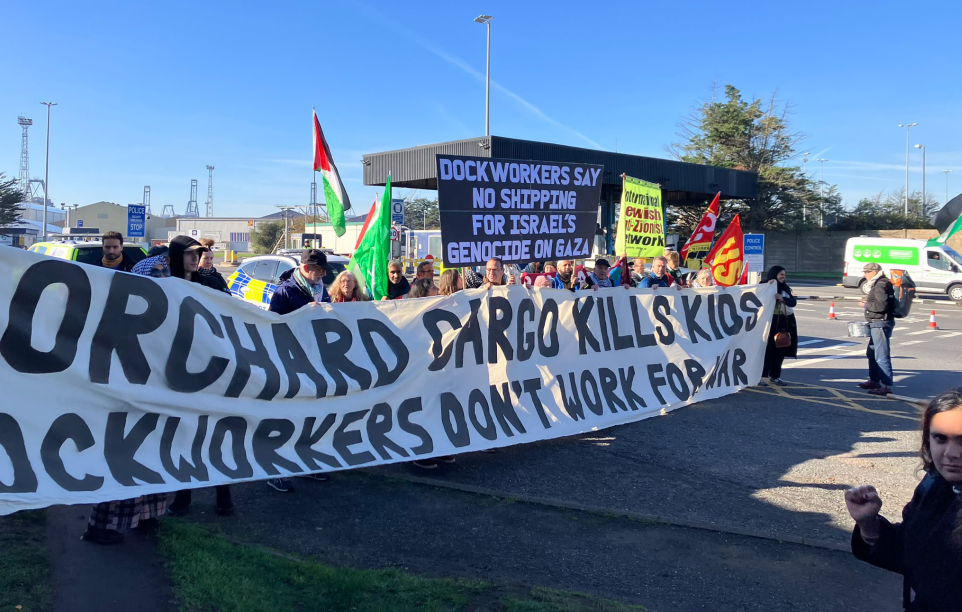
On Friday 30th October 2026, groups of dockworkers, trade unionists, pro-Palestinian and anti-war campaigners gathered at the front gates of Tilbury docks to call on the lorry drivers and the dockers to “Stop Shipping Weapons to Israel”. In the UK, dockworkers and their allies organised protests in Belfast, Tilbury and Liverpool in opposition to the transport of weapons and military equipment to Israel. These actions did not lead to walkouts at Tilbury but dockers did so in Australia, Cyprus, Denmark, France, Germany, India, Mexico, Morocco, Spain, Sweden, Turkey, the USA and Uruguay.
More than 25 unions across five continents refused to handle weapons shipments to Israel, staging 24-hour strikes and other actions, including work stoppages and demonstrations of varying durations. Unions in France, Italy, Greece, Spain, Turkey and Morocco issued a joint call for an end to wars in the Middle East, including the war on Gaza, and “an end to the militarisation of ports”.
Campaign organisers estimated that the co-ordinated actions affected approximately 52,000
containers and cargo worth $2.8 billion. Italy witnessed some of the largest mobilisations of the
day, as the grass-roots Unione Sindacale di Base (USB) called a 24-hour nationwide strike, linking opposition to war and military spending with demands for higher wages, stronger public services and relief from the rising cost of living. And in France the General Confederation of Labour (CGT) organised a 24-hour stoppage in the ports and docks that, according to union reports, achieved participation exceeding 90 per cent.
The action marked the 2nd International Day of Global Action by dockworkers around the world, answering the call of the World Federation of Trade Unions (WFTU) with strikes and demonstrations at 113 ports across 22 countries. And all this whilst major anti-war and anti-austerity strikes and protests unfolded throughout Europe against austerity, repression, militarisation, rearmament and genocide. At Tilbury, protestors holding Irish and Palestinian flags held banners saying “Workers Do not Work for War!”, and “Stop Shipping genocide!”. In spite of police restrictions, they managed to distribute leaflets to workers and lorry-drivers, whilst some passing cars and container trucks on the highway nearby hooted in support.
Drums, megaphone speeches and coordinated chants linked the repudiation of genocide in Gaza with the appalling arming of Israel and the war-readiness exhortations of our UK government. The participants, some 150 to 200, loudly demanded an immediate embargo on all arms exports. Their leaflet, specifically addressed to the dockworkers, called on them to refuse to handle any arms shipment to Israel.
Activists from the French and Italian dockworkers’ unions waved large French CGT and Italian USB trade union flags, alongside that of the British RMT. The comrades holding the RMT flag came from the Piccadilly & District West RMT branch, supported by anti-war organisations as well as by Southwark, Brent and Greenwich trades councils. Some members of Unite did take part at one time. There were representatives of Health Workers4Palestine, Medical Aid for Palestinians (MAP), UK Doctors for Palestine and others. One of the activists present had sailed and suffered on the Mavi Marmara flotilla.
This mobilisation included strikes and demonstrations spanning five continents. It brought together tens of thousands of workers to strike or protest against the shipment of arms, the militarisation of ports, the genocide of the Palestinian people, the war waged by the USA and Israel against Iran, the arms supply to Zelensky in the Ukraine war, and the transformation of ports into hubs of war.
In countries such as Italy and Greece, there were large protests directly from dockers. In India, the Forward Seamen’s Union (FSU) reported that the dockworkers and the seafarers had raised their voice across Indian ports; they had walked off the job in Mumbai around slogans such as “Ports for Peace” and “Jobs with Dignity”. They published a document explaining how they took action “to link the fight against war with the fight for collective labour agreements, wage increases, stable jobs, shorter working hours and health and safety; against privatisations, subcontracting and temporary work; against automation and AI used to cut jobs and intensify exploitation”. Technology must reduce the working hours, they said, not feed monopoly profits.
Note that the first international day of action by dockers and port workers was only eight months ago, in February 2026. That involved 20 ports in seven countries. That action laid the groundwork for this second International Day. There is every reason to expect more and more of such actions. These International Days of Action indicate that the global working class is organising internationally, alongside the general population, in readiness to defeat the war of monopoly capitalism not only over Palestine but on human life and life itself.
From a world where the Palestinians and their allies have taken the lead, the anti-imperialist and anti-war struggle penetrates insular Britain regardless of frontiers. The general strike in Italy and the global mass movements show that the war of capitalism is hated and opposed – and that the force exists to have it defeated.
Forward to the greater unification of the World Federation of Trade Unions and the International Transport Workers Federation! Forward with the greater anti-fascist, anti-imperialist and anti-Zionist unification of humanity!
by Marie Lynam