John
John
by New Worker correspondent
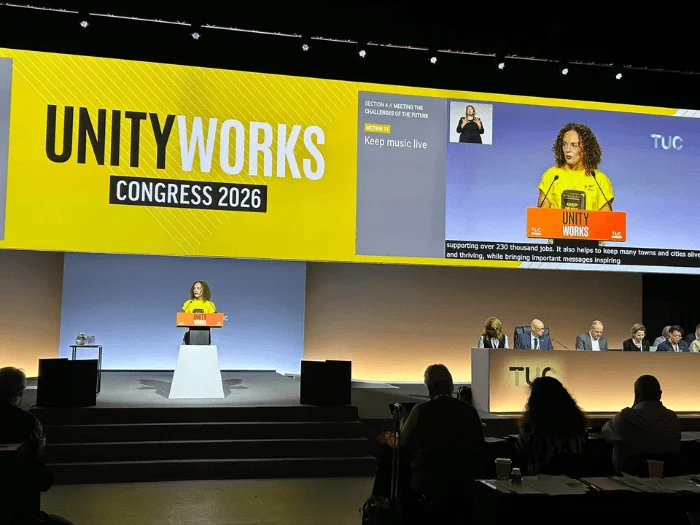
The annual Trades Union Congress has taken place for the 157th time at Brighton. But things aren’t what they used to be. Labour grandees once attended the entire event, paying close attention to what was being said if they knew what was good for their careers.
Few senior Labour politicians were present this year. One was Education Secretary Bridget Phillipson, who came largely to seek support for her bid to become Deputy Labour Leader and to remind delegates she came from a tough northern working-class background.
One notable absentee was Sir Keir Starmer who was present last year, when he had to turn up to thank the TUC for helping to get him elected just months earlier. Now that the honeymoon period is but a distant memory, he either found no pressing need to be present or was terrified that some delegates might not give him a standing ovation.
Ranks of the now almost extinct reed of labour correspondents once attended to fill the broadsheets, tabloids, airwaves and TV screens alike. That no longer happens. In 2011 BBC journalist John Mair noted that:
“In the past, there were enough labour correspondents to mount a cricket team to play the union barons before the Trades Union Congress started each year. Today, they could not umpire that match.”
This year media coverage was very limited. Only the Morning Star, the Beeb and the perhaps the Guardian seemed to have any journalists present. The BBC reported on the TUC’s general secretary’s pleas not to further water down the Employment Rights Bill, but that was about it. Scrolling down newspaper websites in the hope of seeing reports of the cut and thrust of impassioned debate proved to be an unsuccessful undertaking.
The Daily Mail ignored the event but found the energy to mock the striking London Underground drivers for seeking reduced admission rates to Legoland. Visual coverage was confined to the TUC’s YouTube channel, which had less than a thousand viewers for its previous congress. Most of the coverage closely focussed on speakers so that one cannot see how many delegates are listening. One change from the good old days was that delegates get tables and chairs rather than theatre-style seating. That certainly helps fill up the hall.
This indifference is not surprising as today the union movement represents only 22 per cent of the workforce, a record low. In late 2024 there were 6.4 million trade unionists in the UK, in 1979 there were 13.2 million. Even that 22 per cent figure conceals the fact that only 11.7 per cent of private sector workers are unionised (in the public sector it is 49.9). Older and higher paid workers represent the bulk of the membership, with the less skilled and younger workers uninvolved. The fact that trade unionism is in danger of going out of fashion was hardly touched upon.
It was perhaps telling that the only motion to be rejected was one from the Communication Workers Union that that called for: “Innovative and radical thinking on how the TUC carries out its industrial and political work” which means “a top to bottom review of the TUC, including its overall structures, role and purpose in the wider labour movement.” This made a number of suggestions but even though the motion did not make any prescriptive demands, it was clearly too much for the TUC to even think that it could possibly pull up its socks.
Apart from the deplorable membership statistics, one important development reflecting the weakness of the TUC is the news (buried in the annual report) that Congress House is definitely being sold, but to whom and for how much appears still to be uncertain. The conference centre, which was a useful source of revenue, was closed at the end of June and staff made redundant.
In the midst of this decline, it is good to report that there is one ancient TUC tradition which continues unchanged. This is the demand for the TUC to call a general strike to bring in a workers’ government which is made by the Trotskyite Workers Revolutionary Party (WRP) picket every year. At least that makes a change from a general strike to overthrow the Tory government.
The 48 unions belonging to the TUC are a fraction of the 128 registered trade unions, but while the latest General Council Report avoids giving figures these 48
represent about 5.5 million, or the vast majority of trade unionists. Those outside the TUC are very specialist or very grand such as the Royal College of Nursing (RCN).